Thursday, 2 January 2014

Movie Review: The Wolverine

Movie Review: The Wolverine


When film critics aren’t pressed for submission dates it is often a good idea to step back, sigh a little, and then recompose the feeling one got when watching the movie. Now and then, the impact of the movie is so strong that images, sequences — even characters — linger around involuntarily in the consciousness; other times, one draws a blank — an utter, dark, dank, expressionless blank.

This is the case with “The Wolverine”, a present day sequel with Hugh Jackman as the six-foot tall, hairy-chested Canadian Mutant Logan, with kickass healing ability “unbreakable” adamantinum claws and a penchant for hooking up with dangerous dames.

In his sixth Wolverine outing — three X-Men movies, a cameo in X-Men: First Class and the origins prequel also called Wolverine — there’s little Mr. Jackman can do that’s nonconforming to what we know about Logan … and he doesn’t have to. Nonetheless, a brief bit into the past is, of course, statutory to any sequel (especially his).

Here, we open to a slightly unsettling front-seat to the Nagasaki bombing, where Logan saves a soldier’s life. Years later today, the soldier’s runner Yukio (Rila Fukushima) tracks Logan to the backwoods of Yukon with instructions to chaperone him to Japan. The soldier, Yashida (Haruhiko Yamanouchi), now a multi-billionaire technology industrialist lies withering from cancer and hopes Logan’s regenerating mutant-ability would help him out.

Alas, once there, Logan finds himself on the other end of some nasty stares (and some pointy katana’s) from Yashida’s son Shingen (Hiroyuki Sanada), the in-line heir who gets side-stepped by daddy in favor of granddaughter Mariko (Tao Okamoto). A wildcard wedged into a daytime family soap, Logan runs away with Mariko (with the best of intentions, of course), while literally contending with Jean Grey’s (Famke Jenssen) specter, whom he dispatched in The Last Stand.

Logan’s girl-trouble, along with some mean action on top of a Shinkansen (the Japanese bullet train) leads to more girl-trouble, more action and not really that much storytelling (the screenplay is by Mark Bomback and Scott Frank).

The only gradual build-up is the movie’s own lack of consequence. We know Logan is hampered, and that there will be no shortage of visual effects (some choppy, few fine), and that there will be a big-brawl in the end — this time with a tin-battle suit.

On the production front though, Japan (custom built on sets in Australia by production designer François Audouy), is a mix of the soothing, the monotonous and the weird — in particular when Logan and Mariko check into a Love Motel. The effect is very much like the real place: a subjective amalgam of the past and present, secluded to particular districts. Tough luck, the sights only offer minute distraction.

Actually there is one other aspect worth rooting for: the mock father-daughter relationship between Logan and Yukio, who also is an effective assassin — and a co-mutant.

As the movie runs it’s relatively easy under-appreciating the ease of Mr. Jackman’s transition from a vulnerable killer to prized lab-rat tothat of afather figure for Ms. Fukushima’s Yukio(who also responds with an excellence bounce of performance).

While director James Mangold 3:10 to Yuma; Knight & Day doesn’t gush over sensational, specious, flair of the big-budget one is under contract to spend(well, sometimes), he still doesn’t consolidate the screenplay’s slack into an engaging experience. A few mutant-vs.-Yazuka fights here, a few mutant-vs.-mutant fight there — a slinky villainess, played by Svetlana Khodchenkova in a green designer figure-hugging body-suit, is adept at poisoning people — and The Wolverine is good to go.

Fanboys (who I would be one of too), would love to tick off and go bonkers over names like: The Silver Samurai, The Viper, and throwaway end credit teaser cameos for "X-Men: Days of the Future Past," but that would be equal to doing an essay on the futility of trending blockbusters.

Directed by James Mangold; Produced by Lauren Shuler Donner and Hutch Parker; Written by Mark Bomback and Scott Frank; Cinematography by Ross Emery; Edited by Michael McCusker; Music by Marco Beltrami; Production design by François Audouy; Costumes by Isis Mussenden.

Starring: Hugh Jackman, Hiroyuki Sanada, Famke Janssen, Will Yun Lee, Rila Fukushima, Tao Okamoto, Svetlana Khodchenkova and Haruhiko Yamanouchi. Released by 20th Century Fox, “The Wolverine” is rated PG-13. Claws snap out, slice people dead, and all that jazz.

When film critics aren’t pressed for submission dates it is often a good idea to step back, sigh a little, and then recompose the feeling one got when watching the movie. Now and then, the impact of the movie is so strong that images, sequences — even characters — linger around involuntarily in the consciousness; other times, one draws a blank — an utter, dark, dank, expressionless blank.

This is the case with “The Wolverine”, a present day sequel with Hugh Jackman as the six-foot tall, hairy-chested Canadian Mutant Logan, with kickass healing ability “unbreakable” adamantinum claws and a penchant for hooking up with dangerous dames.

In his sixth Wolverine outing — three X-Men movies, a cameo in X-Men: First Class and the origins prequel also called Wolverine — there’s little Mr. Jackman can do that’s nonconforming to what we know about Logan … and he doesn’t have to. Nonetheless, a brief bit into the past is, of course, statutory to any sequel (especially his).

Here, we open to a slightly unsettling front-seat to the Nagasaki bombing, where Logan saves a soldier’s life. Years later today, the soldier’s runner Yukio (Rila Fukushima) tracks Logan to the backwoods of Yukon with instructions to chaperone him to Japan. The soldier, Yashida (Haruhiko Yamanouchi), now a multi-billionaire technology industrialist lies withering from cancer and hopes Logan’s regenerating mutant-ability would help him out.

Alas, once there, Logan finds himself on the other end of some nasty stares (and some pointy katana’s) from Yashida’s son Shingen (Hiroyuki Sanada), the in-line heir who gets side-stepped by daddy in favor of granddaughter Mariko (Tao Okamoto). A wildcard wedged into a daytime family soap, Logan runs away with Mariko (with the best of intentions, of course), while literally contending with Jean Grey’s (Famke Jenssen) specter, whom he dispatched in The Last Stand.

Logan’s girl-trouble, along with some mean action on top of a Shinkansen (the Japanese bullet train) leads to more girl-trouble, more action and not really that much storytelling (the screenplay is by Mark Bomback and Scott Frank).

The only gradual build-up is the movie’s own lack of consequence. We know Logan is hampered, and that there will be no shortage of visual effects (some choppy, few fine), and that there will be a big-brawl in the end — this time with a tin-battle suit.

On the production front though, Japan (custom built on sets in Australia by production designer François Audouy), is a mix of the soothing, the monotonous and the weird — in particular when Logan and Mariko check into a Love Motel. The effect is very much like the real place: a subjective amalgam of the past and present, secluded to particular districts. Tough luck, the sights only offer minute distraction.

Actually there is one other aspect worth rooting for: the mock father-daughter relationship between Logan and Yukio, who also is an effective assassin — and a co-mutant.

As the movie runs it’s relatively easy under-appreciating the ease of Mr. Jackman’s transition from a vulnerable killer to prized lab-rat tothat of afather figure for Ms. Fukushima’s Yukio(who also responds with an excellence bounce of performance).

While director James Mangold 3:10 to Yuma; Knight & Day doesn’t gush over sensational, specious, flair of the big-budget one is under contract to spend(well, sometimes), he still doesn’t consolidate the screenplay’s slack into an engaging experience. A few mutant-vs.-Yazuka fights here, a few mutant-vs.-mutant fight there — a slinky villainess, played by Svetlana Khodchenkova in a green designer figure-hugging body-suit, is adept at poisoning people — and The Wolverine is good to go.

Fanboys (who I would be one of too), would love to tick off and go bonkers over names like: The Silver Samurai, The Viper, and throwaway end credit teaser cameos for "X-Men: Days of the Future Past," but that would be equal to doing an essay on the futility of trending blockbusters.

Directed by James Mangold; Produced by Lauren Shuler Donner and Hutch Parker; Written by Mark Bomback and Scott Frank; Cinematography by Ross Emery; Edited by Michael McCusker; Music by Marco Beltrami; Production design by François Audouy; Costumes by Isis Mussenden.

Starring: Hugh Jackman, Hiroyuki Sanada, Famke Janssen, Will Yun Lee, Rila Fukushima, Tao Okamoto, Svetlana Khodchenkova and Haruhiko Yamanouchi. Released by 20th Century Fox, “The Wolverine” is rated PG-13. Claws snap out, slice people dead, and all that jazz.

Far Cry 3 pc game review

Far Cry 3 pc game review

The Far Cry series is an odd beast. The first title was as much a graphical showcase as a game thanks to its stunning island scenery, cheesy voice acting and horrible AI. The developers, Crytek, then went on to make the futuristic Crysis series, while the Far Cry name passed to Ubisoft.
Far Cry 3
It's an island paradise... apart from the pirates. And the snakes
Far Cry 2 followed: a malaria-induced descent into madness in an African nation on the brink of civil war. It was unrivalled for atmosphere, but the repetitive gameplay was a bit of a turn-off.
Far Cry 3 is a bit of a hybrid of the first and second games, with some Assassin's Creed thrown in (which seems to be the inspiration of choice for big titles at the moment, as shown by Bethesda's steampunk stab-em-up Dishonored).
It's an open-world shooter set on an island somewhere between the Indian and Pacific Oceans. The game starts off with quite a jolt. After a montage of you and your friends drinking, partying and skydiving, having the time of your lives, you wake up chained to a bamboo cage with a Mohican-toting madman standing over you.
You've been captured by pirates, and it's up to you, Jason Brody, to rescue your friends and get the hell off the island. As action heroes go, Brody is an unlikely one. While Far Cry and Far Cry 2's protagonists had military or mercenary backgrounds, which at least explained their ability to reload an assault rifle in three seconds, you're just an over-privileged Californian bro in his early twenties stuck in a nightmare situation.
Far Cry 3
Dennis. He's pretty cool
The disconnect between the pampered Americans and the unadulterated barbarity of pirates operating on the fringes of civilization lends itself well to much of the game's tension, as well as Jason's character development. Under the guidance of the island's native Rakyat warriors, he morphs from a terrified innocent into a tattooed assassin, bristling with weapons and high on home-made drugs - in the process becoming increasingly distant from his friends.
The open-world model means Far Cry 3 has more in common with RPGs such as Skyrim than Modern Warfare 3. You're free to roam around the island (which is absolutely huge) picking up missions and side-quests to earn money and experience. The side missions aren’t a patch on Skyrim's immersive extra quests, and mainly involve boilerplate assassinations, vehicle racing or hunting a specific animal, so it's easy enough to ignore them and get on with the main mission if you so wish. However, gaining experience is useful, as this unlocks skill points to spend on special moves such as stealthy takedowns, faster movement and increased damage resistance.
The story missions, of which there are an enormous 38, are generally remarkably varied, and become gradually more bizarre as the game goes on; you progress from blowing up pirate ammo dumps to Indiana Jones-style quests in trap-filled ancient ruins, with some drug-induced hallucinations along the way. At first we found the game difficult to get into. When you start, you're only capable of carrying one weapon and a couple of magazines, which means you constantly run out of ammo in a firefight, and have to fall back on stealth and your trusty machete.
Far Cry 3
Dr. Earnhardt. He's definitely not stoned
To even the odds, it's vital to learn the art of crafting. Everything you need in Far Cry 3 can be fashioned in the jungle from the skins of various animals. By hunting and skinning everything from dogs to wild boar to komodo dragons and tigers, you can increase your ability to carry weapons, ammunition and explosives. You can also take advantage of the planet's native fauna to make medicines and performance-enhancing drugs, which help you with everything from holding your breath for longer to spotting animals from a distance.

Tomb Raider (2013) game review

Tomb Raider (2013) game review

Tomb Raider is a 2013 action-adventure video game published by Square Enix. Tomb Raider is the fifth title developed by Crystal Dynamics in the Tomb Raider franchise. As the first entry in a new Tomb Raider continuity, the game is a reboot that emphasises the reconstructed origins of the culturally influential lead character Lara Croft. Tomb Raider was released on 5 March 2013 for Microsoft Windows, PlayStation 3 and Xbox 360.
TombRaider2013.jpgAfter the release of Tomb Raider: Underworld in 2008, Crystal Dynamics began development of Tomb Raider soon after. Rather than a sequel, the team decided to completely reboot the series, establishing the origins of Lara Croft for the second time, following Tomb Raider: Legend. Tomb Raider is set on Yamatai, an island from which Lara Croft must save her friends and escape while being hunted down by a malevolent cult. Gameplay elements focus more on survival, although exploration is used within the game when exploring the island and various optional tombs. It is also the first game in the series to have multiplayer and the first game to be published by Square Enix, after the latter's acquisition of Eidos Interactive in 2009. Camilla Luddington was announced to voice and perform as Lara Croft in 2010, replacing Keeley Hawes.
After a delayed release from late 2012 to March 2013, the game received much anticipation and hype. Tomb Raider received critical acclaim upon release, with critics praising the graphics, the gameplay, Luddington's performance as Lara, and Lara's characterization and development, although the addition of the multiplayer mode was criticised. Tomb Raider sold one million copies within 48 hours of its release, and has sold more than 4 million copies overall. An updated version, Tomb Raider: The Definitive Edition, will be released in January 2014 for PlayStation 4 and Xbox One containing all features and DLC.

Gameplay

 
Tomb Raider is presented in third-person perspective, and the player takes control of the lead character, Lara Croft: the game uses an interconnected hub-and-spoke model that combines action-adventure, exploration, and survival mechanics. Lara can traverse between the camps and across the island using footpaths, improvised or already-available ziplines and climbable tracks. Many of Lara's moves are carried over from the previous games created by Crystal Dynamics, with some tweaks added, such as incorporating elements of stealth gameplay. Quick Time Events are scattered at regular intervals throughout the game, often appearing at crucial or fast-moving points in the game's plot, such as two early ones where Lara has to extract a shard of metal from her side, then later escape a collapsing cave. The combat of the game borrows multiple elements from the Uncharted series, with the player having the ability to free-aim Lara's bow and the guns she salvages, engage in close-quarter combat and perform stealth kills.Added to Lara's abilities is Survival Instinct, a mode where enemies, collectables and objects pivotal to environmental puzzles will be highlighted for the player. The game also incorporates RPG elements: as the player progresses through the game, they earn experience points from performing certain actions and completing in-game challenges linked with hunting, exploring and combat: this enables Lara Croft's skills and abilities to be upgraded in specific ways, such as giving her more storage capacity for arrows and ammunition. Players can also upgrade and customize weapons using salvage collected across the island. There is also a character progression mechanic in the game: better items, weapons and equipment is gained as the player progresses, though the appearance of most of these items is closely linked to events in the story.[11] Karl Stewart said that the game's campaign lasts between 12 and 15 hours. Along with the main story, players will have the chance to do multiple side quests, explore the island, revisit locations, and search for challenge tombs.

Multiplayer

Tomb Raider also includes an option for players to compete with each other in several multiplayer maps, a first for the series. In each multiplayer match, there are two enemy teams: four survivors and four scavengers, and there are three types of games for multiplayer to compete in, played in five different maps: the modes are Team Deathmatch, Private Rescue and Cry for Help. The first mode is a simple PvP combat scenario, with teams pitted against each other, and the winning team being the one to kill of the opposing team in three separate matches. In the second mode, the "survivors" team must take medical supplies to a specific point on the map, while the "scavengers" must reach a certain number of kills, both within a ten-minute time limit. The third mode, Cry for Help, involves the "survivors" exploring the maps and retrieving batteries for defended radio beacons while being hunted by the "scavengers". Across all three modes, weapons and destroyable environments from the single-player campaign are carried over.

Synopsis

Characters

The player takes on the role of Lara Croft, a young and ambitious archaeology graduate whose theories on the location of the lost kingdom of Yamatai have convinced the Nishimura family—descendants from the people of Yamatai themselves—to fund an expedition in search of the kingdom. The expedition is led by Dr. James Whitman, a celebrity archaeologist who has fallen on hard times and is desperate to avoid bankruptcy, and is accompanied by Conrad Roth, a Royal Marine turned adventurer and close friend of the Croft family who serves as mentor to Lara; Samantha "Sam" Nishimura, Lara's friend and a representative of the Nishimura family who films the expedition for a documentary; Joslyn Reyes, a skeptical and temperamental mechanic and single mother; Jonah Maiava, an imposing and placid fisherman who is willing to believe in the existence of the paranormal and esoteric; Angus "Grim" Grimaldi, the gruff Glasweigan helmsman of the Endurance; and Alex Weiss, a goofy and bespectacled electronics specialist.

Setting

The game is set on Yamatai, an island in the Dragon's Triangle off the coast of Japan. The island—and the kingdom that once existed there—is shrouded in mystery, given its reputation for fearsome storms and shipwrecks that litter its coastline. Yamatai was once ruled by a queen named Himiko, known by her honorific title of "Sun Queen", who according to legend was blessed with shamanistic powers that enabled her to control the weather. Very little is known about Yamatai's history in the time since Himiko's death, other than that the island's infamy was established shortly thereafter. In exploring the island, the player may find evidence that—among others—Portuguese traders, United States Marines and a Japanese military project were all stranded on Yamatai at various points throughout history.
At the start of the game, the island is populated exclusively by the Solarii Brotherhood, a violent cult of criminals, mercenaries and shipwreck survivors. The Solarii Brotherhood has established its own society based on the worship of Himiko, complete with a social structure and laws, with their exact purpose and intentions being explored over the course of the story.

Plot

The game begins with Lara setting out on her first expedition aboard the ship Endurance, with the intention of finding the lost kingdom of Yamatai. By her suggestion and against Whitman's advice, the expedition ventures into the Dragon's Triangle, east of Japan. The ship is struck by a violent storm and split in two, leaving the survivors stranded on an isolated island. Lara is separated from the others when she is captured by a strange, savage man and trapped in his cave home. She manages to escape while her captor is killed as the cave collapses around them. As Lara tries to locate the other survivors, she finds more evidence that the island is inhabited, complete with strange carvings, dead bodies, and ritual sacrifices of animals. She eventually finds her friend Sam and a man called Mathias, who claims to be a teacher who was shipwrecked on the island. As Sam tells Mathias the legends of Himiko, Lara passes out; when she wakes, Mathias and Sam are nowhere in sight.
When Lara finally reunites with the other survivors, Whitman decides to break off from the main party with Lara and search for Roth, who is still missing, while the rest of the group (Reyes, Jonah, Alex and Grim) set out to find Sam and Mathias. As Lara and Whitman explore, they discover that the island's inhabitants are worshipping Himiko, confirming that the island is Yamatai. Upon discovering a shrine erected in Himiko's name, they are captured by the islanders and taken to a settlement along with several other survivors from the Endurance. When the survivors attempt an escape, the captors turn on them. Lara is separated from Whitman and tries to hide, but is found by Vladimir, one of the leaders of the inhabitants. Vladimir attacks Lara, but she fights back and is forced to kill him to save her own life. She fights off the remainder of the inhabitants as she desperately works her way up the mountainside to meet up with Roth. Eventually, Lara locates the injured Roth, and using his equipment, she sets off for a communications relay at the very top of the mountain, in hopes of contacting the outside world and calling for aid.
After successfully hailing a plane that was searching for the Endurance and setting a signal fire for them to follow, Lara witnesses a fierce storm materialise out of a clear sky and strike the plane down, accompanied by a mysterious voice saying "No one leaves" in Japanese. Feeling responsible for the fate of the pilots, Lara is powerless to stop the island's inhabitants from killing them. Lara is contacted by Alex and Reyes, who reveal that Sam has been kidnapped by the islanders, a violent cult known as the Solarii Brotherhood. Lara, who is closest to Sam's position, tries to rescue her, but is foiled by Mathias - now revealed to be the leader of the Solarii - who orders her killed. Lara is saved by the intervention of strange samurai-like creatures—referred to by the islanders as 'Oni', demons in Japanese folklore—and taken to an ancient monastery in the mountains. Escaping again, Lara stumbles onto a ritual chamber, where she learns that a "fire ritual" was used to choose the Sun Queen's successor as part of a ceremony called the "Ascension". A terrified Sam manages to contact Lara and informs her that the Solarii intend to put her through the fire ritual, which will burn her to death if it is unsuccessful. Lara makes for the Solarii fortress, meeting up with Grim, but the Solarii capture the latter and threaten to murder him unless she surrenders. Grim attempts to overpower them, but eventually sacrifices himself so Lara can escape. Roth then arrives, and with his support, Lara is able to infiltrate the palace, where she witnesses Mathias putting Sam through the fire ritual. Lara tries to save Sam, but she is overpowered by Mathias and his men. The ritual continues, but Sam is not harmed by the flames, which are extinguished by a great gust of wind, marking her as the rightful successor to the Sun Queen's throne.
Lara narrowly escapes captivity once again and doubles back to help her friends, whose attempts to reach Sam have resulted in their capture. Aided by Whitman—who has managed to negotiate some degree of freedom with the Solarii—Lara returns to the palace to rescue Sam as Roth commandeers a helicopter to get them out. Having witnessed the storm that forced the search plane to crash, Lara sends Sam to escape by land and tries to force the pilot to land as a second storm brews up, striking the helicopter and forcing them to crash. Lara is nearly killed in the accident and is revived by Roth. However, Mathias and the Solarii arrive, and Roth takes a fatal blow meant for Lara. While mourning over Roth, Lara accepts that the storms are not natural, but are somehow connected to the Sun Queen and designed to prevent anyone from leaving the island. She meets up with the other survivors, who have evaded the Solarii long enough to secure a boat for escaping the island, provided that it can be repaired. They are joined by Whitman, who claims to have escaped, though Lara begins to suspect him of working with the cultists. Lara heads for the wreck of the Endurance to meet up with Alex, who had previously gone there to salvage the tools needed to repair the boat. She finds him trapped under wreckage and, as she attempts to free him, they come under attack by the Solarii. Alex decides to trigger an explosion and sacrifice himself so that Lara can escape with the tools.
Finding an account of a World War II-era Japanese military and Nazi scientific expedition to the island that sought a way to harness the power of the storms as a weapon, Lara decides to explore an ancient tomb on the coast, where she finds the remains of a high-ranking samurai who had committed seppuku. It is revealed, in a message he left, that he was the general of the Queen's Stormguard, the Oni that defend the monastery, and that the Queen's successor took her own life rather than receive the Sun Queen's power, leaving the Sun Queen trapped in her body after death, and her rage has manifested as the storms. Lara realises that the Ascension is not a ceremony to crown a new queen, but rather a ritual that transfers the original Sun Queen's soul into a new body, and that the process will destroy the host's soul. Himiko's spirit wants to escape its current body, and Mathias plans to offer Sam as a new host. Lara returns to the survivors on the beach to find that Whitman has betrayed them, abducting Sam and handing her over to Mathias. Lara, Jonah and Reyes give chase, heading up a river to the monastery, with Lara arriving just in time to see Whitman killed by the Oni. After fighting her way through the Queen's guards, Lara arrives at the top of the monastery in time to see Mathias start the Ascension ritual. She works her way to Mathias, confronting Solarii and guards alike. Lara kills Mathias when she shoots him from the roof of the monastery using (Lara Croft's iconic) two pistols, before destroying Himiko's remains to save Sam. With the storms dispersed, Lara, Sam, Reyes and Jonah leave the island and are picked up by a cargo ship. As she and her friends sail home, Lara decides that there are many more myths to be found and resolves to uncover them, stating that she isn't returning home just yet.

Development

Following Tomb Raider: Underworld, Crystal Dynamics was split into two teams; the first beginning work on the next sequential pillar of the Tomb Raider franchise, while the second focusing on the newly created spin-off Lara Croft series (debuting with Lara Croft and the Guardian of Light in 2010). Following pre-announcement media hype while the game's title was under embargo, in November 2010, Square Enix filed for trademark of the slogan for the new Tomb Raider game; "A Survivor is Born". On 6 December 2010, Square Enix announced Tomb Raider had been in production for nearly 2 years; "Square Enix Ltd. is excited today to announce Tomb Raider, the new game from Redwood City based studio Crystal Dynamics". Studio head Darrell Gallagher said, "Forget everything you knew about Tomb Raider, this is an origins story that creates Lara Croft and takes her on a character defining journey like no other". Game Informer website and magazine ran a world exclusive cover reveal in its January 2011 issue, as well as exclusive coverage of emerging details directly from Crystal Dynamics from 12 December 2010. Tomb Raider was the first game in the series to receive a M rating in the United States.
In January 2012, when asked if the game would be available on Nintendo's Wii U console, Crystal Dynamics global brand director Karl Stewart responded there are no plans to have the game available on that platform. According to Stewart, the reason for this is that "it would not be right" for the game to simply be ported, as the developers built the game to be platform-specific before the Wii U was announced, and goes on to mention that if they started building the game for the platform "[they] would build it very differently and [they] would build it with unique functionality." The multiplayer mode was created by Canadian video game development studio Eidos Montreal, known for making Deus Ex: Human Revolution. In May 2012, it was announced by Darrell Gallagher, the studio head of Crystal Dynamics, that the game has been delayed and would be due for release in the first quarter of 2013. He said: "We're doing things that are completely new to Tomb Raider in this game, and the additional development time will allow us to put the finishing touches into the game and polish it to a level that you deserve. We believe this is the right choice, and I guarantee it will be worth the wait."

Animated model

Lara Croft's model is animated using compiled performance capture, a technique used in the previous installment Tomb Raider: Underworld. The game was built on Crystal Dynamics's game engine called the "Crystal Engine". Lara´s face is based on that of model Megan Farquhar. On 3 June 2011, the "Turning Point" CGI teaser trailer premiered at the Electronic Entertainment Expo 2011, emphasizing the release date was to be in the third quarter of 2012. The trailer was produced by Square Enix's CGI studio Visual Works.

Voice cast

Keeley Hawes did not return as Lara Croft for 2013's Tomb Raider, after completing Tomb Raider: Legend, Anniversary, Underworld and Lara Croft and the Guardian of Light. Her contribution spanned four years; the longest role of any of Croft's voice actresses in English. In December 2010, Crystal Dynamics was said to be trialling dozens of voice actresses. On 26 June 2012, the voice actress of Lara Croft was revealed to be Camilla Luddington. Lara is played by Nadine Njeim in the Arabic dub, by Nora Tschirner in the German dub, by Alice David in the French dub, by Karolina Gorczyca in the Polish dub, by Yuhko Kaida in the Japanese dub, by Benedetta Ponticelli in the Italian dub, by Guiomar Alburquerque Durán in the Spanish dub and by Polina Sherbakova in the Russian dub.

Gameplay showcases

On 31 May 2012, a new gameplay trailer was released online, showcasing more action-based gameplay along with varying plot elements. The trailer also confirms the presence of several other non-playable characters besides Lara on the island, many of which appear to be in a menacing organization, much like in previous instalments in the franchise. On 4 June 2012, at Microsoft's E3 2012 press conference, a new gameplay demonstration was shown, depicting environmental destruction and other interactivity, stealth combat using a bow and arrow, quick-time events and parachuting. During summer 2012, gameplay was shown of Lara hunting, exploring the island and killing for the first time. They were shown at EuroGamer Expo 2012 at London on 27 September 2012. On 8 December 2012, a new trailer was shown during Spike Video Game Awards. At the beginning, an introduction was made by Camilla Luddington and during the event, the trailer was followed by a musical orchestra, led by the music composer, Jason Graves. The next week, IGN presented: Tomb Raider Week. Each day from Monday to Friday, exclusive previews, features and trailers were released, showing more details for the upgrading system, survival tools and challenge tombs. Tomb Raider officially went gold on 8 February 2013.

Reviews

Reception
Aggregate scores
AggregatorScore
GameRankings(X360) 87.41%[88]
(PS3) 86.71%[89]
(PC) 86.69%[90]
Metacritic(PS3) 87/100[91]
(X360) 86/100[92]
(PC) 86/100[93]
Review scores
PublicationScore
Eurogamer8/10[94]
Famitsu38/40[95]
Game Informer9.25/10[96]
GamesRadar4.5/5 stars[97]
GameSpot8.5/10[98]
GameTrailers8.5/10[99]
IGN9.1/10[100]
Joystiq4/5 stars[101]
Official PlayStation Magazine (UK)8/10[102]
Digital Spy5/5 stars[103]
The Guardian4/5 stars[104]
Tomb Raider received critical acclaim upon release, with most critics agreeing that it was a solid and long-overdue reboot for the franchise. In a 'world exclusive' review, GamesMaster magazine gave the game a score of 90%, as well as the "GamesMaster Gold award" (awarded to games that manage a score of 90% or above). The editor regarded the quality of the visuals, the length and depth of the gameplay, and the "spectacular" last third of the game as the highlights. The summary said "sitting back exhausted we were left with just one question dribbling forth from our gaping jaws. How on earth are they going to top this in the sequel? Because of one thing there can be no doubt. Lara is back." IGN's Keza MacDonald also spoke extremely positively, stating that they felt the game was "exciting" and "beautifully presented", included "great characterization" and "more depth than you would expect". They gave the game an overall score of 9.1 out of 10, the highest score they have given a game in the series since Tomb Raider, describing it as "amazing" and concluding that the game "did justice" to both the character and franchise. Ryan Taljonick of GamesRadar lauded the location's setting and environment, and expressed that "not one area ever feels like a rehash of another". Taljonick also felt that the game had great pacing, and that it is "unrivaled by any other game in the genre". Furthermore, the reviewer considered Lara's character development as "an integral part" of the whole game's experience, and concluded that Tomb Raider "is a fantastic game and an excellent origin story for one of gaming's original treasure seekers". Australian TV show, Good Game, praised the game with both hosts rating it 10/10, making it only the eighth game out of the show's seven-year run to do so. Giant Bomb gave the game four stars out of five, stating that "Tomb Raider's tone is somewhat at odds with its action, but the reborn Lara Croft seems primed for a successful new adventuring career".
One of the major criticisms of the game stemmed from a disparity between the emotional thrust of the story and the actions of the player, with GameTrailers' Justin Speer pointing out that while the story attempted to characterise Lara Croft as vulnerable and uncomfortable with killing, the player was encouraged to engage enemies aggressively and use brutal tactics to earn more experience points. Speer felt that this paradoxical approach ultimately let the game down as it undermined Lara's character to the point where he found it difficult to identify with her at all. IGN's Keza MacDonald also highlighted the issue, but was less critical of it than Speer, pointing out that both Lara and the player had to adapt quickly to killing in order to survive. However, Game Informer's Matt Miller noted that the game offered the player several options for progressing through its combat situations, and that the player could avoid open conflict entirely if they chose to do so. He also praised the behaviour and presence of the enemies for the way they felt like they had actual tasks to perform on the island, rather than being clusters of polygons whose only function was to be killed by the player in order for them to progress. While on the subject of character development, GamesRadar's Ryan Taljonick expressed that the supporting characters were underdeveloped relative to Lara Croft, describing them as "pretty generic characters who, while rarely annoying, just aren't memorable".
While many reviews applauded the single-player campaign, the multiplayer mode bore the brunt of the game's criticism, with MacDonald, Speer and Miller all finding fault with it, describing it as lackluster and stating that the difference between the developer's vision for the game mode and the finished product made it difficult to enjoy.

Call of duty black ops II review

Call of duty black ops II review

A sinister villain, some tough choices, and a new kind of multiplayer arena invigorate the reliably intense action in Call of Duty: Black Ops II.

Jetpacks with rigid wings. Gloves that can adhere to any surface and support your body weight. Advertisements that feature your face when you walk by. The campaign in Call of Duty: Black Ops II has some interesting ideas about the future of technology, but what about the future of this massively popular shooter series? On the one hand, Black Ops II introduces new mission types and dramatic decision points that liven up the campaign, as well as a league play option that represents a fundamental shift in the franchise's hallowed multiplayer mode. On the other hand, the campaign hits the same satisfying rhythms, the multiplayer captures the same frenetic intensity, and the cooperative zombies mode delivers the same stale undead-massacring action. Caught between striving for the future and remaining rooted in the past, Black Ops II finds solid footing, providing another great ride on the Call of Duty rollercoaster.
The ride starts off a bit rough as Black Ops II makes good on its pre-campaign warning of graphic content. Two early scenes linger on people burning alive, and while one ends up contributing to character development, the other is just gratuitous. Later cutscenes don't flinch from depicting gory violence, though of all the unpleasant sights you see throughout the story, the playful (and not at all gory) post-credits video might be the most appalling.
Fortunately, the campaign boasts an engaging story and a lot of entertaining action. It features the lead characters from the originalCall of Duty: Black Ops, and though it references events from the past, a clear narrative thread emerges that is easy to follow. You jump between two time periods: the present, which is the year 2025, and the past, which spans about a decade during the Cold War. The narrative reflections of the elderly Frank Woods (a protagonist from Black Ops) weave these two timelines together, but the character that truly drives the story is the villain, Raul Menendez. During the Cold War missions, you follow Menendez's origin story and rise to power. In the 2025 missions, you desperately try to avert his catastrophic master plan. This parallel character development is deftly handled, infusing your missions with undercurrents of curiosity and urgency.
Things get even more intense when you are asked to make a choice. Press one button to kill a target, the other to let him live. The conditions of each choice vary and there are only a few of them, but even when you aren't responding to a prompt, you might be making a choice in a dramatic moment that will have consequences later. The main course of the campaign remains constant, but these decisions do affect the fate of some key characters. A few of these moments are sure to give you pause, adding some welcome weight to the proceedings. Once you've seen the story through, there's a handy rewind feature that lets you play earlier levels in order to see how different paths play out. There are also mission-specific challenges that give you ancillary goals to complete while you do so, further increasing the replay incentive.
The new millimeter scanner sight can highlight hidden enemies.
You can also see some variance in the available strike missions, which are a new type of campaign level. These stages put you in a squad of soldiers and drones, and then let you choose which asset to control at any given time. Defending installations against enemy assault, escorting a convoy, and rescuing a hostage are some of the endeavors you might undertake. Though you can set targets for the team under your command, strike missions are still all about you gunning down foes. Your AI allies are only good at slightly hindering your enemies, so you end up doing the heavy lifting yourself, often while tracking activity on multiple fronts and hopping around to deal with advancing enemies. Having to consider the bigger picture is a nice change of pace for a series that has mostly involved just shooting what's in front of you, and these missions are a welcome shot in the arm for the familiar campaign pacing.
Of course, familiar as it may be, that pacing is still great. The campaign ebbs and flows as you move through a variety of diverse, detailed environments using an array of powerful weaponry to dispatch your foes, occasionally hopping into a jet or on to a horse for a short jaunt, or manning a missile turret to tame a swarm of hostile drones. A few neat gadgets and surprising gameplay moments satisfy the novelty quotient, but you still get the lingering feeling that you've done this all before. The new strike missions, dramatic decision points, and memorable villain help keep this concern at bay, however, and this fiesty, enjoyable romp is more enticing to replay than other recent Call of Duty campaigns.
Black Ops II's competitive multiplayer has seen some changes as well, notably in the way you equip yourself before going into battle. The COD points system from Black Ops has been ditched in favor of a new token system that still affords you some control over the order in which you unlock new weapons and gear. The more interesting change is the new loadout system, which gives you ten points to play with and assigns a single point to every element of your loadout (guns, attachments, perks, lethal and tactical items). It offers a bit of flexibility if, say, you don't use a sidearm much but could really use an extra perk, and the new wild cards allow some limited creativity. Put one of these in your loadout, and you can go into battle with two well-equipped primary weapons, or you can load up on perks and bring just a knife and your wits.
Mounted guns are risky in multiplayer, but oh, so deadly.
These are two extreme examples, but tweaking your loadouts with the gear you've chosen to unlock still confers a sense of getting more powerful and better equipped for combat. These are still the fast and deadly battlefields that have drawn millions of players for years. Positioning and reflexes are king, firefights are over in the blink of an eye, and success is rewarded with deadly equipment and satisfying experience gains. New gear, new weapons, and new score streak rewards are sprinkled throughout, offering new martial capabilities and strategic wrinkles. Traditional gametypes and a few rule-bending party games all offer familiar frenetic fun, but one new mode of play holds the potential to really shake things up.
When you first enter league play, you must play a few rounds so that Black Ops II can calculate your skill level. Then, you are placed in a division, and your subsequent league play games pit you against players who are roughly your skill level (your numbered rank is not displayed). You can rise and fall in the league standings, and at certain intervals, leagues will be recalculated to allow players to move up to the bigs or get busted down to the minors. Whether you relish running with the wolves or are tired of getting trampled, the quality of play increases when players are better matched.
League play also represents a significant change in competitive play because everything is unlocked from the start. This kind of freedom was previously relegated to the small ponds of custom games, but now there's an ocean of players who have all chosen from the same available options when they enter a match. This levels the playing field and lets you leverage the full power of the Black Ops II arsenal right from the start, which is great news for players tired of having their options restricted. However, this also means that you don't gain experience in the way you may be used to; the only XP you get from league play is a nominal reward at the end of a match. Without the ever-present possibility of completing challenges, unlocking new gear, and leveling up, league play feels detached from modern Call of Duty tradition. It's a strange sensation, but it feels liberating, allowing you to focus on the action at hand without the temptation to play in certain ways to target certain rewards. League play has the potential to shift the way that people play the game they've been enjoying for years, and that's an exciting prospect.
There are also some new sharing tools aimed at making the multiplayer experience more social and more extroverted. You can link your PC to your YouTube account and live stream your league play matches without having to purchase extra streaming software or capture equipment. This accessibility is appealing, but there are substantial barriers that limit this feature. The first is audience; you must have at least 10 viewers on your stream before it will go live. The game gives you a link to share and leaves you to recruit a crowd. The second barrier is technical. Call of Duty has long boasted high frame rates that make the action slick and speedy, but the games we streamed and viewed ran at slower, chunkier frame rates, as well as low resolutions. Watching a pale shadow of Black Ops II is hardly appealing, so your best sharing bet is still theater mode. There, you can watch your previous matches, edit highlight clips (or let the game take a shot at it for you), grab screenshots, and upload media to share with those on your friends list and the community at large.
Another new feature, so-called "codcasting," aims to introduce a new player type to the Call of Duty scene. By queuing up a game film and selecting this feature, you can watch the match with a suite of tools that let you highlight the action. You can track different players, watch certain areas with a free-roaming camera, and even use a picture-in-picture mode to see the standings and the action side by side. Though this has the potential to allow players to generate some dynamic, entertaining play-by-play videos, its current manifestation is very limited. You can only codcast saved films of games you have played in, and unless you can provide your own streaming solution, your only potential audience is the five other players you could invite in to your lobby. Future updates to this feature could make it more useful, but as of now it just feels like a shell of what it could be.
Sorry, zombie, that hazmat suit is no match for the ray gun.
Black Ops II also heralds the return of zombies mode. Now in its third incarnation, this cooperative survival mode is still frantic, challenging, and home to some weird humor. But though some of the new missions play with the formula by adding a bus to catch or a competing team to watch out for, the core action has grown stale. Shooting the bullet-sponge zombies lacks the satisfying immediacy that Call of Duty thrives on, and dealing with their lurching, single-minded attacks grows dull even as they get faster and more numerous. The new maps feature veins of fire that flare up when you cross them and obscure your vision, adding more visual sludge to the already murky environments. Perhaps the fire is intended as some kind of platforming challenge--jumping frequently seems to be the best way to avoid it--but hopping around doesn't make the environments any less ugly or the enemies any less boring.
Though zombies mode is stagnating, the rest of Black Ops II is lively, and it's great to see some shifting in the familiar structure. Developer Treyarch's storytelling prowess has once again resulted in an engaging, exciting campaign, and the addition of league play to the online multiplayer arena is an intriguing change that could reinvigorate the formula that has endured for so long. By reaching forward while remaining rooted in the things it does so well, Black Ops II offers a great shooter experience.

Splinter Cell: Blacklist review

Splinter Cell: Blacklist review


Splinter Cell: Blacklist is a stealth game of the robust, rule-based kind, where each environment is a puzzle waiting to be cracked. You slip snake cameras under doors or use sonar vision to get the lay of the land. Then, you pick a route and use the gadgets you’ve brought with you to eliminate each guard in order. Blacklist has more of old Splinter Cell in it than Conviction did, but it’s not a perfect revival of the series.
It’d really like it if you saw it that way, however. Sam Fisher has been plucked out of retirement, shaved, given some moisturiser, and plonked in charge of Fourth Echelon, a younger and sexier take on the spy agency from the original games. 4E roams the world in Paladin, a spy plane that enables Sam and a gang of new and old sidekicks to breach international law wherever and whenever they please.
On a minute-to-minute basis, the level design is an issue. Having a range of gadgets to use means less if you don’t need to use them at all, and Blacklist’s linear series of arenas rarely need to be manipulated as carefully or on as large a scale as in Splinter Cell of old. ‘Realistic’ difficulty changes this somewhat, removing Conviction’s ‘mark and execute’ feature – which allows you to tag groups of enemies for later elimination – as well as axing midmission resupply caches and reducing the usefulness of sonar goggles. Being forced to rely on your noisemakers and sticky cameras more is great, but it doesn’t prevent environments from feeling narrow and stagey. When you come across a climbable pipe, you know that a developer somewhere expects you to climb it – and that it’ll probably lead you conveniently over the head of that armoured guard you couldn’t figure out how to get past.
The supremacy of certain gadgets accentuates the problem. Consider the crossbow. A mission or two will earn you the funding you need to pick up this silent weapon and all of its ammo types, enabling you to fill a single gadget slot with a device that can shoot EMP bolts, taser bolts, noisy bolts, and sleeping gas bolts that instantly wipe out gaggles of enemies all at once, difficulty level be damned. On multiple occasions in the campaign, Fisher will have to escape an area with a hostage under one arm. These sections force you to rely on whatever weapon you were holding when the sequence began. To help you out, you’re assigned infinite ammo for no particular reason – and I stumbled into one wielding the crossbow with sleeping bolts. The result was a ridiculous charge down a riverside as Sam Fisher mercilessly ushered commando after commando into a deep and restful repose.

Awkward, hand-holdy sections like this are the game’s other great weakness. There’s the obligatory bit where you escape from a burning building, and an early mission begins with a sniper section where you must eliminate enemies in the right order to allow Fisher to progress. Logically, you might assume that if you screw up then the subsequent stealth section will become harder. Not so – you have to repeat it until you do it perfectly.
Optional side missions unlocked by speaking to Sam’s crew are playable in solo and co-op modes and present you with open areas that promise to fix the campaign’s problems. One set, where you’re asked to clear areas of enemies before progressing, offers a good balance of stealth and action and rewards creativity. Another set, however, resets you to the start of the mission if you’re ever detected. There’s no checkpointing, and Blacklist has no mid-mission save system. This turns features that should be positive – like the guard patrols that vary from run to run – into crushing negatives. Flawless stealth is an exercise in gruelling trial-and-error.
Every mission in the game can be repeated for points, which are assigned based on your performance in one of three categories: Ghost, Panther,and Assault. Ghost means slipping by undetected and non-lethally subduing guards you can’t avoid. Panther is similar but you’re allowed to kill people, and Assault is for people who would rather be playing a shooter. But Blacklist leans on its scoring system to provide you with consequences for the way you choose to play: the main narrative doesn’t respond to your choices at all. Lethal or non-lethal is a high-score decision, rendering toothless the infrequent moments when you’re asked if you’re willing to spare a life.
This is a Tom Clancy story, and therefore it is about some government people, their gadgets, and a series of politically motivated explosions whose grounding in real politics is conveniently woolly in the way that a flock of sheep resting at the bottom of a slippery slope is conveniently woolly. Fans of the genre will note that the principal threat is not an EMP, for once, but is something rather a lot like an EMP.

Wednesday, 1 January 2014

Boss hindi movie review

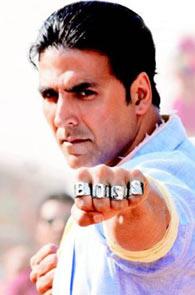
Akshay Kumar in BossBoss hindi movie review

Review: Akshay Kumar's Boss: All title, no thunder!

 
This movie knows only one language. From Danny Denzogpa, the Big Boss to the debutante actor Shiv (Shiv Pandit), almost every male in this film is beating the pulp out of some goon or the other at every given time and frame. The only exception is the gentle Masterji Satyakant Shastri (Mithun Chakraborthy), whose shining virtue is that he has only slapped twice in his life, in a world full of fist-happy men.

A still from the film
Boss is about the misunderstanding between Boss (Akshay Kumar) and his sometimes-limping, sometimes-not father, the Masterji, that happens over a murder. While the father disowns him, the Big Boss, impressed with his performance in a street brawl, adopts him. The father is forced to seek his help when the younger brother (Shiv) falls in love with a girl, Ankita (Aditi Rao Hyadari) and eventually gets caught in the clutches of her arrogant and corrupt policeman brother Ayushman Thakur (Ronit Roy).
The film gets on your nerves from the first reel itself, as violence is dished out in various forms, at every given opportunity. In spite of the presence of some stellar actors like Danny (still looking hot), Mithun and even Sanjay Mishra (who plays the coughing, sneezing sidekick of the Boss), one starts losing interest from the first reel itself. It is like getting a non-stop ringside-view of a fighting arena where people are researching new ways of smashing up each other’s faces. But it is Akshay Kumar’s entry, which breathes life into this film. Needless to say, the boss gets the wittiest lines, the coolest role and of course, he handles it with much aplomb. Once he comes on the screen, he manages to lighten up the scene and evokes some smirks and giggles.
Shiv Pandit is tolerable when he is not flying around and kicking people. Aditi Rao has nothing to do except look helpless and coy, as is expected from this testosterone-driven film. If you are an Akshay Kumar fan and appreciate his comic timing, watch this one. But if action is not your favourite genre, you have the full danger of coming out feeling as battered and beaten as one of those innumerable goons in the film.

Singaravelan malayalam movie review

Singaravelan malayalam movie review

Singaravelan

What we expect from a Dileep-Lal-Shajon- Baburaj combo is a fun filled rollercoaster ride from the word go! Unfortunately, the first half is a bit lengthy and not as entertaining and engaging as expected, since the 'comedy' element is a bit lacking here. Sringara Velan is three hours long and since it is not as funny as Dileep's previous films, the audience will be a little disheartened. In spite of its negative points, Sringara Velan is not a complete disappointment as it is a mass entertainer. The film is likely to do very well among the kids and women audience of Dileep. Story Sringara Velan is a comedy packed entertainer in which Dileep plays the lead role, while Babu Namboothiri plays the role of his father who is a weaver. He sends his son Kannan played by Dileep to study fashion designing, but Dileep has some other plans. His ambition is to become very rich and accumulate as much wealth as possible. Though he tries many different ways to make money, he fails. This creates tensions between the father and son. Rasda is his love interest and Yesu is his partner in crime. The various characters in the film gets into all sorts of problems and the way in which they free themselves out of all these problems form the crux of the plot. The humourous turn of events in the film leave you in splits. Verdict Sringara Velan is a typical festival film meant to entertain the audience. Don't expect too much, but go for it! Cast: Dileep, Vedhika, Lal, Baburaj, Babu Namboodiri, Ambika Mohan Director: Jose Thomas Producer: Jason Elagulam Music Director: Berny Ignatious Dileep-Lal-Shajon-Baburaj are extremely funny and the audience just can't stop laughing when the trio appear on screen! The scene in which Lal appears on the screen as an astrologer is hilarious!